Why use a vacuum truck for industrial cleaning? The answer begins with control, not convenience. In refineries, cement plants, wastewater facilities, and manufacturing sites, crews often face sludge, dust, liquid waste, and abrasive residues. A vacuum truck can collect these materials through sealed hoses, reducing open handling and limiting spills around drains, pumps, and machinery.
The U.S. Occupational Safety and Health Administration identifies exposure control as a core part of hazardous operations. Its Respirable Crystalline Silica Standard emphasizes engineering controls, housekeeping, and safer work practices. OSHA’s data also shows that silica exposure remains a serious concern across construction and general industry. See OSHA, Respirable Crystalline Silica: https://www.osha.gov/silica-crystalline. NIOSH recommends using the hierarchy of controls to reduce worker exposure, especially when dust and contaminated residues are present. See NIOSH, Hierarchy of Controls: https://www.cdc.gov/niosh/hierarchy-of-controls/.
The equipment is not a magic solution. That assumption can fail. Operators still need site assessments, compatible hoses, filtration checks, confined-space procedures, and trained supervision. EPA guidance on industrial waste management also stresses proper characterization, containment, and documented handling. See EPA, Industrial Waste Management: https://www.epa.gov/land-research/industrial-waste-management. In practical terms, a well-planned vacuum truck can remove wet sludge from a pit without sending workers inside. It can recover dry material from a transfer area before wind spreads it. The strongest results come from matching truck capacity, vacuum pressure, filtration, and disposal planning to the actual material. Small details matter. Safety depends on them.
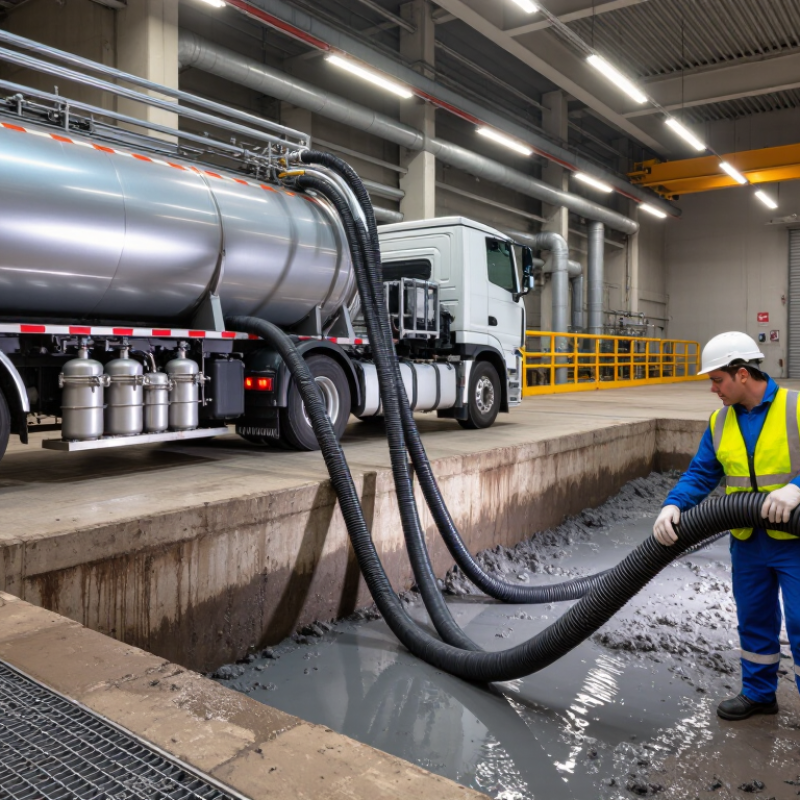
A vacuum truck is a mobile recovery system for industrial cleaning. It uses a powerful blower to create negative air pressure inside a sealed collection tank. Atmospheric pressure then pushes liquid, sludge, dust, or loose solids through a reinforced hose.
The truck separates materials before discharge. Cyclones or filters remove larger particles, while the tank stores collected waste safely. Some units handle wet material, dry dust, or both. Operators adjust airflow and suction for each task. A blocked hose can reduce performance quickly. Small details matter.
The U.S. Environmental Protection Agency’s industrial stormwater guidance lists vacuum sweeping as a practical method for removing sediment and pollutants from paved surfaces. OSHA’s Respirable Crystalline Silica standard sets an eight-hour exposure limit of 50 micrograms per cubic meter. Proper vacuum capture can support dust-control plans, although it cannot replace air monitoring or suitable respiratory protection.
In field operations, technicians often inspect hoses, seals, filters, and tank capacity before entering a work area. A 6-inch hose may move heavy sludge efficiently, but it can be difficult to position around congested equipment. Larger airflow is not always better. Excess suction may disturb fragile surfaces or overload filters. The U.S. National Institute for Occupational Safety and Health emphasizes engineering controls, yet real sites remain unpredictable. Cleaning plans sometimes look perfect on paper. They still need adjustment beside the equipment.
| Data Dimension | What It Means | Typical Industrial Cleaning Data | Practical Benefit or Application |
|---|---|---|---|
| Basic Definition | A vacuum truck is a heavy-duty mobile unit that collects dry solids, liquids, sludges, and mixtures through a suction hose. | It combines a truck-mounted vacuum pump, collection tank, filtration equipment, hoses, and discharge equipment. | It can perform cleaning and material recovery at locations where fixed vacuum systems are unavailable or impractical. |
| Operating Principle | The vacuum pump removes air from the suction system, creating a pressure difference that moves material through the hose. | Airflow carries the collected material into the tank, where solids and liquids are separated from the conveying air. | The system supports controlled removal of material from pits, vessels, trenches, sumps, floors, and process areas. |
| Main Material Types | Vacuum trucks are selected according to the physical properties of the material being removed. | Common materials include dry dust, sand, gravel, ash, wastewater, sludge, oily liquids, production residue, and wet solids. | One mobile unit can address several cleaning conditions when the tank, pump, hose, and filtration configuration are suitable. |
| Collection Tank Capacity | The tank stores recovered material before transport or controlled discharge. | Typical industrial units commonly have capacities of approximately 10–30 cubic yards, depending on truck design and payload limits. | Larger tanks can reduce trips to a disposal or treatment facility, while smaller tanks may improve access in confined sites. |
| Vacuum Strength | Vacuum level indicates the pressure difference available to lift and convey material. | Industrial vacuum systems commonly operate across a broad range, often up to approximately 27–28 inHg for high-vacuum liquid and sludge work. | Higher vacuum capability helps lift dense, wet, or heavy material, but the correct setting must match the hose, distance, material, and equipment limits. |
| Airflow Capacity | Airflow determines how effectively the system transports material through the hose. | Typical high-volume industrial configurations may provide roughly 2,000–6,000 cubic feet per minute, depending on the pump and operating conditions. | Higher airflow is useful for dry solids and long hose runs, while material density and hose diameter also strongly affect performance. |
| Hose Diameter | Hose diameter affects conveying capacity, suction velocity, and the size of material that can pass through the system. | Industrial hoses are commonly available in approximate internal diameters from 2 to 8 inches, with larger sizes used for bulkier solids. | Correct hose selection reduces blockages, improves productivity, and helps protect the vacuum pump from unnecessary loading. |
| Dry Vacuum Configuration | Designed primarily for powders, dust, granular solids, and other dry materials. | Usually includes a high-airflow blower or pump, dust filtration, a debris tank, and a system for controlled solids discharge. | Suitable for removing process dust, spilled powders, sand, ash, and aggregate without relying on manual sweeping or compressed air. |
| Liquid and Sludge Configuration | Designed to collect free liquids, slurry, and semi-solid waste. | Often uses a liquid-rated tank, vacuum pump, liquid shutoff protection, and bottom or rear discharge equipment. | Useful for sumps, drains, settling basins, wastewater areas, stormwater systems, and industrial spill response. |
| Wet-and-Dry Configuration | A combination system capable of handling both liquid and dry material within approved operating limits. | Requires compatible filtration, tank design, separation controls, and operating procedures to prevent liquid carryover into the pump. | Provides operational flexibility for facilities with changing cleaning requirements, reducing the need for separate equipment types. |
| Filtration Function | Filters protect the vacuum pump and help control dust released from the exhaust air. | Systems may use cyclonic separation, cartridge filters, bag filters, or high-efficiency filtration selected for the material and hazard profile. | Effective filtration improves air quality, supports regulatory compliance, and reduces wear caused by abrasive particles. |
| Cleaning Reach | Reach is influenced by hose length, elevation, bends, material density, and required airflow. | Industrial hose runs may extend from several metres to more than 30 metres when the equipment and material conditions allow. | Remote suction can reduce the need for workers to enter tanks, pits, vessels, or contaminated areas. |
| Typical Productivity Factors | Actual productivity depends on the material and site conditions rather than tank capacity alone. | Key factors include material density, moisture, hose diameter, hose length, lift height, access, tank loading, and discharge time. | A site assessment helps determine the correct truck configuration and prevents underperformance caused by unsuitable equipment selection. |
| Industrial Applications | Vacuum trucks are used wherever bulk material must be removed safely and transported for reuse, treatment, or disposal. | Applications include tank cleaning, pit cleaning, sewer and drain maintenance, catalyst recovery, spill cleanup, excavation support, and plant housekeeping. | They provide a flexible alternative to manual removal, portable vacuum units, pumps, and water-intensive cleaning methods. |
| Worker Safety | Remote vacuuming can separate workers from the material being collected. | Workers may operate from outside a confined space using hoses, cameras, barriers, and approved access procedures. | It can reduce exposure to sludge, dust, chemical residues, biological hazards, and unstable material, although confined-space rules still apply. |
| Hazardous Materials | Hazardous-material service requires equipment and procedures appropriate for the substance and site classification. | Considerations may include chemical compatibility, grounding and bonding, static control, explosion protection, respiratory protection, and waste classification. | Proper planning helps control fire, explosion, toxic exposure, corrosion, and cross-contamination risks. Equipment suitability must be verified before work begins. |
| Water Usage | Vacuum removal can collect material directly instead of flushing it with large volumes of water. | Water consumption varies by task; dry vacuuming may require little or no process water, while hydro-excavation and washdown require substantially more. | Reduced water use can lower wastewater volume, cleanup time, and treatment or disposal requirements for suitable dry-material tasks. |
| Waste Transport | The collected material remains contained in the truck tank during movement to an approved destination. | Discharge may occur through a rear door, bottom outlet, tipping mechanism, or pressure-assisted unloading system, depending on the truck design. | Contained transport can reduce secondary spills and simplify movement of recovered material between the worksite and treatment facility. |
| Maintenance Requirements | Regular inspection keeps the vacuum system reliable and reduces unplanned downtime. | Important checks include filters, hoses, couplings, relief valves, tank seals, shutoff devices, pump lubrication, and corrosion protection. | Preventive maintenance helps preserve suction performance and reduces the risk of pump damage, leaks, hose failure, and filter blockage. |
| Best Selection Criteria | The truck should be matched to the material, access conditions, hazard level, and disposal method. | Evaluate material state, density, temperature, chemical compatibility, required vacuum, airflow, hose distance, tank volume, filtration, and discharge method. | Correct matching improves cleaning efficiency, protects workers and equipment, and avoids unnecessary operating and disposal costs. |
Note: The numerical ranges shown are typical industry values for general planning only. Actual performance varies by equipment configuration, material properties, site layout, operating conditions, and applicable safety requirements.
It removes sludge, dust, and deposits through sealed hoses. Workers shovel less material by hand. Cleaning can finish faster. Not always perfectly.
Operators can keep the truck outside restricted areas. This reduces contact with slippery floors and unstable waste piles. Sealed hoses also limit splashing and airborne dust.
Crews should inspect hoses, couplings, filters, gauges, and tank levels. They should identify the material and choose suitable protective equipment. A clear exclusion zone is essential.
One operator watches pressure gauges and tank levels. Another guides the hose near the waste. This reduces sudden hose movement and helps prevent overfilling.
A liquid vacuum truck is designed for wastewater, sludge, and recovered fluids. Its tank should resist moisture and corrosion. Check its recovery capacity before work begins.
A dry vacuum truck handles dust, powders, and loose solids. It may collect cement residue, metal fines, or dried process waste. Wet material can reduce performance.
It handles liquids and settled solids in the same area. For example, a sump may contain grit beneath standing water. This can avoid separate cleaning stages.
Wet material may settle inside hose bends. Filters may load faster than expected. Poorly planned access points can also change the schedule. Small adjustments help, but plans can fail.
Why use a vacuum truck for industrial cleaning? A vacuum truck is a specialized mobile system that uses powerful suction to collect liquids, sludge, dust, debris, and other industrial waste into a sealed tank for controlled transport. Unlike ordinary cleaning equipment, it combines high-capacity collection with flexible operation, making it suitable for tank cleaning, pit and sump maintenance, spill recovery, pipeline support, sediment removal, and general facility cleanup.
Vacuum trucks improve efficiency by removing large volumes of material quickly while reducing manual handling, exposure to hazardous environments, and the risk of spills. Different configurations may include wet vacuum systems, dry material units, combination trucks, or models designed for high-pressure cleaning. Selecting the right truck requires evaluating the material, volume, access conditions, suction distance, filtration needs, and worksite requirements. Proper inspection, trained operation, secure hose connections, and routine tank maintenance are essential for safe, reliable, and efficient performance.

 Yale Truck