Airport crash tenders are not ordinary fire engines. They are mobile rescue systems designed for intense aircraft fires, limited access, and seconds of decision-making. So, what are the requirements for an airport crash tender? The answer begins with the airport’s ICAO rescue and firefighting category, aircraft dimensions, response-time target, and local operating conditions.
ICAO Annex 14 and the Airport Services Manual, Part 1, connect airport category levels with firefighting agent quantities, discharge rates, and response performance. The FAA’s AC 150/5210-13C adds practical guidance on Aircraft Rescue and Fire Fighting vehicle design, crew protection, communications, and equipment placement. ICAO’s 2024 Safety Report also keeps runway safety and accident survivability at the center of airport planning. These documents provide authority, but they do not replace a site-specific risk assessment. This guide has limits.
As ARFF instructor Paul Schuette has stated, “The truck is only as effective as the crew, agent, access, and response plan working together.” That principle matters beside a runway. A tender may carry thousands of litres of water, foam concentrate, dry chemical, breathing apparatus, and rescue tools. Yet poor visibility, uneven pavement, blocked taxiways, or delayed command decisions can reduce its value quickly. NFPA 414 also highlights vehicle performance, agent systems, crashworthiness, and maintainability. Real requirements include more than tank capacity. They include acceleration, braking, turning radius, pump reliability, foam proportioning accuracy, thermal protection, and continuous training. Some specifications still look complete on paper, but deserve closer testing in realistic drills.
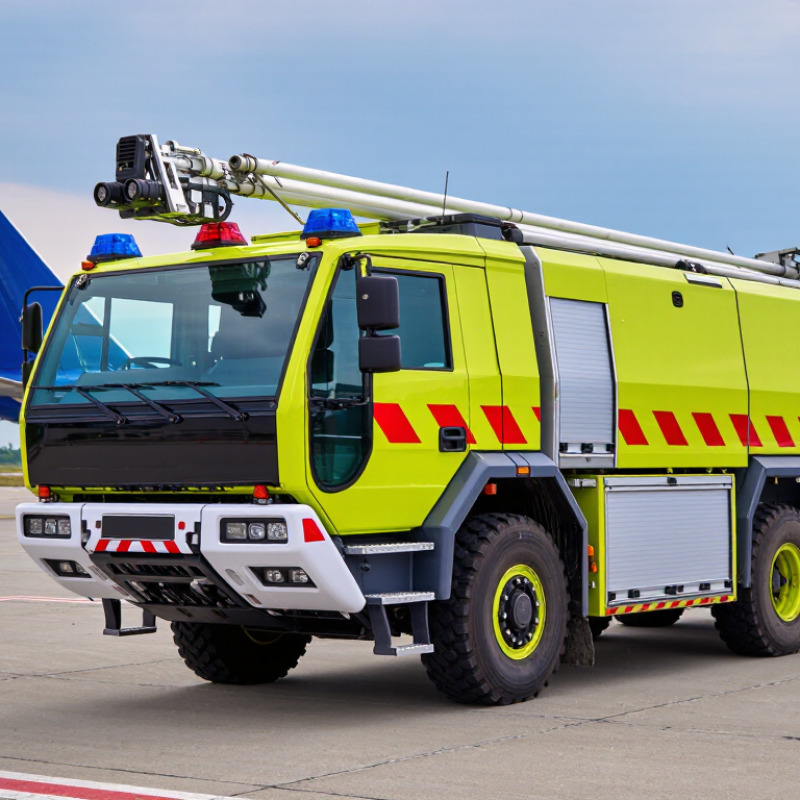
Airport crash tenders are specialized emergency vehicles designed for aircraft accidents, fires, and rescue operations.
They carry large water supplies, foam agents, rescue tools, breathing equipment, and medical gear. Their main role is rapid intervention near runways, taxiways, and aircraft stands.
Seconds matter.
A crash tender must reach an incident quickly, often across uneven ground and restricted airport areas. Strong acceleration, reliable braking, all-wheel drive, and clear visibility support safer movement.
High-capacity pumps deliver extinguishing agents around aircraft fuselages, engines, and landing gear. Crews also create access points, control hazards, and assist passengers during evacuation.
Requirements should match airport size, aircraft types, runway layout, climate, and emergency response time. A vehicle can meet a specification yet perform poorly if training is weak. That possibility needs honest review.
Tips:
Inspect pumps, hoses, lighting, radios, and rescue tools before every shift. Practice night operations and reduced-visibility driving. Record response times during realistic drills. Keep water and foam levels verified. Review maintenance records, not just inspection stickers. No checklist is perfect. Crew feedback may reveal problems that routine testing misses.
Airport crash tenders must turn stored capacity into immediate rescue performance. ICAO Annex 14 sets a response objective of three minutes to any runway point, under optimum conditions. That target includes driving, positioning, and initial agent application. A tender therefore needs rapid acceleration, dependable braking, clear visibility, and stable handling on wet pavement. The vehicle should also support pump-and-roll firefighting, adjustable discharge, and safe access for rescue crews. These are operational requirements, not decorative specifications.
Extinguishing capacity must match the airport’s aircraft rescue category. FAA Advisory Circular 150/5210-13C links ARFF vehicle design with agent delivery, turret performance, chassis capability, and crew safety. NFPA 414 testing further examines water systems, foam discharge, vehicle stability, braking, and equipment protection. Data sheets should show usable flow rates, tank capacities, reach, refill time, and performance at maximum load. Numbers without test conditions can mislead.
03 Field experience exposes a harder issue. A tender may pass a static inspection yet struggle on a crowded apron, uneven shoulder, or smoky runway. Operators should record response drills, turning paths, pump engagement time, and visibility limitations. Human factors matter. One overlooked control can delay the first discharge. ICAO guidance also stresses suitable access routes, communications, and coordinated rescue planning. Requirements should be reviewed after every exercise, because real incidents rarely follow the clean assumptions written into a procurement document.
In 2026, an airport crash tender must balance speed, water capacity, visibility, and crew protection. ACI World reported 8.5 billion global passenger trips in 2023. That volume increases pressure on emergency response systems. Design should support rapid acceleration, stable cornering, and controlled braking on wet pavement. NFPA 414 specifies performance criteria for aircraft rescue and firefighting vehicles, including acceleration, braking, pump capacity, and vehicle stability.
Response time remains critical. ICAO Annex 14 and the Airport Services Manual identify a three-minute maximum response objective for reaching any runway location. Some airports set tighter internal targets. Vehicle layouts should provide direct access to foam controls, roof turrets, handlines, and breathing equipment. Large windows, thermal imaging support, and high-intensity scene lighting improve visibility during smoke, rain, or night operations. Small details matter.
Firefighting equipment must match the airport’s aircraft mix and rescue category. Foam systems require accurate proportioning, dependable monitors, and clearly marked controls. FAA AC 150/5210-13C also emphasizes testing, training, and operational readiness. Maintenance records should track pump output, tire condition, braking distance, and foam quality. A vehicle can meet specifications on paper yet fail during a steep, crowded, or contaminated approach. That uncomfortable gap deserves regular field testing. Not every checklist reveals it.
| Requirement Area | Requirement or Design Benchmark | Key Data / Minimum Consideration | Why It Matters | Primary Reference |
|---|---|---|---|---|
| Airport Rescue and Fire Fighting Category | Determine the required aircraft rescue and fire fighting category from the aerodrome reference aircraft length and fuselage width. | ICAO rescue and fire fighting categories are numbered 1 through 10. The selected category determines vehicle numbers, extinguishing-agent quantities, and discharge performance. | Prevents under-capacity protection for the largest aircraft routinely using the airport. | ICAO Annex 14, Volume I, Chapter 9 |
| Response Time | Position vehicles and stations so the rescue and fire fighting service can reach the operational runway area rapidly after an alert. | ICAO operational objective: response time should not exceed 3 minutes to any part of each operational runway in optimum visibility and surface conditions. An optimum objective of 2 minutes is specified where practicable. | Rapid arrival supports initial fire attack and improves occupant survivability. | ICAO Annex 14, Volume I, Chapter 9 |
| Vehicle Quantity | Provide the number of dedicated rescue and fire fighting vehicles required for the selected aerodrome category. | ICAO category 1 generally requires at least 1 vehicle; categories 2 through 5 generally require at least 1 vehicle; categories 6 through 10 generally require at least 2 vehicles. Local regulators may impose higher quantities. | Maintains sufficient agent capacity, redundancy, and operational availability. | ICAO Annex 14, Volume I, rescue and fire fighting service provisions |
| Main Extinguishing Agent | Use water for producing foam as the principal extinguishing agent, with a foam system suitable for aviation fuel fires. | Water quantity is category-dependent and is calculated using the applicable aviation foam performance level and discharge rate. The vehicle should support accurate proportioning and monitoring. | Foam rapidly separates fuel from oxygen and limits re-ignition on aircraft fuel spills. | ICAO Annex 14; applicable national aerodrome regulations |
| Supplementary Extinguishing Agent | Carry a supplementary agent, normally dry chemical powder or another authority-approved agent, for rapid flame knockdown. | Capacity and discharge rate must comply with the selected regulatory category and the vehicle approval standard. The system should have independent pressure, hose, and nozzle controls. | Improves performance against pressurized, localized, or three-dimensional fires. | ICAO Annex 14; NFPA 414; national fire-service requirements |
| Foam Proportioning | Provide a calibrated proportioning system that maintains the specified foam-concentrate percentage throughout the operating range. | The system should include a visible or electronically monitored concentration setting, flushing provisions, and a test connection. Common concentrate settings depend on the approved foam agent and applicable standard. | Incorrect concentration can reduce extinguishing performance and increase environmental or maintenance risks. | NFPA 414; foam-agent approval documentation |
| Roof Turret | Install a remotely controlled roof turret capable of applying foam or water while the vehicle is moving or stationary, where permitted. | Provide a wide horizontal and vertical aiming range, controlled flow selection, protected controls, and adequate visibility from the cab or camera system. | Allows an initial attack from a safer distance and supports large-area fuel-fire suppression. | NFPA 414; vehicle type-approval requirements |
| Piercing or Under-Run Nozzle | Consider a piercing nozzle or under-aircraft discharge system for direct application beneath or inside an aircraft fuselage, subject to aircraft and airport procedures. | The system requires protected mounting, controlled penetration force, operator interlocks, and a dedicated agent supply or flow path. | Can deliver agent to concealed fire areas when external access is restricted. | NFPA 414; local aircraft rescue procedures |
| Pump and Water System | Use a high-capacity pump, protected plumbing, reliable priming, and controls accessible from the cab and ground operating positions. | The pump must meet the required turret, handline, and monitor flow simultaneously or in the specified operating combinations. Include pressure relief and drain systems. | Ensures stable discharge under changing terrain, agent selection, and hose configurations. | NFPA 414; manufacturer performance testing |
| Chassis and Off-Road Mobility | Select a chassis designed for rapid acceleration, high gross vehicle mass, all-wheel drive, and operation on paved and unpaved airport surfaces. | Specify traction control, differential locks where appropriate, sufficient ground clearance, large approach and departure angles, and suspension rated for the fully loaded vehicle. | Airport incidents may occur away from paved roads or on damaged and contaminated surfaces. | NFPA 414; airport vehicle operating conditions |
| Braking and Stability | Provide braking, electronic stability, anti-lock braking, rollover resistance, and load-control systems suitable for the maximum operating mass. | Validate stopping distance, lateral stability, axle loads, center-of-gravity changes, and water-surge effects with tanks full and partially full. | Reduces collision and rollover risk during high-speed emergency response. | Applicable road-vehicle regulations; NFPA 414 |
| Cab and Crew Protection | Protect occupants from heat, smoke, impact, and contaminated air during approach and initial fire attack. | Include certified seating and restraint systems, positive-pressure ventilation or filtered air where required, heat-resistant glazing, insulated surfaces, and emergency egress. | Allows crews to operate closer to hazards while reducing exposure and injury risk. | NFPA 414; occupational safety regulations |
| Visibility and Lighting | Provide emergency warning lights, scene lighting, illuminated controls, high-visibility markings, and effective windscreen and mirror systems. | Lighting must not create unacceptable glare for aircraft operations. Markings should remain visible in darkness, rain, smoke, and low-visibility conditions. | Improves crew awareness and reduces secondary vehicle collisions. | ICAO Annex 14; national vehicle-lighting regulations |
| Communications and Navigation | Integrate approved aerodrome communications, vehicle identification, navigation, and incident-location systems. | Provide aviation-band or approved operational radio capability where required, hands-free crew communication, resilient power supply, and airport-map or moving-map support. | Reduces dispatch delays and helps crews navigate complex movement areas safely. | ICAO Annex 14; aerodrome emergency plan |
| Rescue Equipment | Carry tools for aircraft access, forcible entry, casualty handling, and immediate life safety. | Typical equipment includes hydraulic cutting and spreading tools, power saws, bolt cutters, axes, rescue lines, ladders, first-aid supplies, thermal blankets, and portable lighting. | Fire suppression alone may not provide access to occupants trapped in an aircraft. | ICAO rescue and fire fighting service guidance; NFPA 414 |
| Agent Tank Construction | Use tanks, baffles, supports, valves, and piping compatible with water, foam concentrate, and the vehicle’s operating environment. | Design for corrosion resistance, surge control, inspection access, low-point drainage, overfill protection, and safe filling and venting. | Protects structural integrity and maintains predictable handling during emergency driving. | NFPA 414; applicable pressure, tank, and transport regulations |
| Fire Detection and Thermal Imaging | Provide thermal imaging and, where specified, fire or heat detection to support crew situational awareness. | Cameras should have protected housings, suitable temperature ratings, display redundancy, cleaning provisions, and a clear line of sight to the discharge area. | Helps identify hot spots, hidden fire, and safe approach paths in smoke or darkness. | NFPA 414; airport operational risk assessment |
| Environmental Protection | Select foam agents and operating procedures that comply with current environmental restrictions and airport drainage controls. | Avoid restricted persistent chemicals where prohibited; provide containment, recovery, flushing, and disposal procedures for contaminated water and foam solution. | Reduces soil, groundwater, surface-water, and regulatory risks after training or incidents. | Applicable environmental law; airport environmental management plan |
| Testing and Acceptance | Complete documented commissioning, acceptance testing, and operational drills before placing the vehicle into service. | Test acceleration, braking, steering, stability, pump flow, turret reach, foam proportioning, agent discharge, communications, lighting, emergency shutdowns, and crew ergonomics. | Confirms that the complete vehicle performs as specified rather than relying only on component certificates. | NFPA 414; airport procurement and acceptance procedures |
| Maintenance and Readiness | Maintain continuous operational readiness through inspections, preventive maintenance, agent checks, and recorded functional tests. | Daily or shift inspections should cover fuel, tires, brakes, warning systems, water and foam levels, pump status, nozzles, hoses, communications, and rescue tools. | A technically compliant vehicle is ineffective if it is unavailable or has an undetected system fault. | ICAO Annex 14; airport maintenance program; NFPA 414 |
| Training and Exercises | Train drivers and rescue crews in vehicle operation, aircraft familiarization, foam application, communications, casualty rescue, and incident command. | Conduct regular live-fire or approved simulation exercises, timed response drills, night operations, low-visibility practice, and multi-agency emergency exercises. | Builds reliable performance under the stress and complexity of an aircraft accident. | ICAO Annex 14; airport emergency plan; national training requirements |
Note: Exact vehicle quantities, agent capacities, discharge rates, performance tests, and equipment lists must be confirmed against the airport rescue and fire fighting category, aircraft fleet, applicable national regulations, and the current editions of the referenced standards.
A crash tender is only effective when its crew can act under pressure. ICAO Annex 14, Volume I, recommends reaching any runway point within three minutes. A two-minute response remains the operational objective where practical. These targets demand clear seating, radio discipline, and daily route familiarity. Crews should know hydrant locations, restricted gates, aircraft stand layouts, and seasonal surface risks. A vehicle may carry large water capacity, yet poor coordination can waste critical seconds. That happens more often than training records suggest.
Training should combine live-fire exercises, aircraft mock-ups, breathing apparatus work, and medical triage. FAA Advisory Circular 150/5210-17C links airport rescue training with recurrent proficiency and documented competency. NFPA 1081 also supports role-based qualifications for airport emergency personnel. Supervisors should record turnout time, driving speed, radio clarity, nozzle selection, and crew accountability. Data should be reviewed after every drill. A stopwatch helps, but it can mislead when conditions are unrealistic. Crews need honest feedback, including uncomfortable failures.
Tips: Run short surprise drills during different shifts. Mark blind corners with temporary barriers. Use realistic smoke and low visibility, within safe training controls. Rotate crew roles, but never weaken command clarity. Review one missed action immediately. Keep a paper backup for radio or digital system failure. Training should feel repetitive. Real emergencies rarely do.
2026 Best Airport Crash Tender Requirements Guide
Procurement, Testing, Maintenance, and Compliance Criteria
Selecting an airport crash tender requires more than checking tank size and engine output. Procurement teams should define runway category, response distance, terrain, climate, and crew capacity before requesting quotations. The vehicle should match local rescue procedures, not merely a supplier’s standard configuration. Request verified data for acceleration, braking, turning radius, discharge reach, water capacity, foam proportioning, and cabin visibility. Include operator training, spare parts, technical manuals, and lifecycle costs in the evaluation.
Testing should occur under controlled conditions and realistic loads. Inspectors can measure pump pressure, discharge rate, agent mixing accuracy, lighting, radios, and emergency braking. Test the tender on wet pavement and uneven access routes. Record results with calibrated instruments, photographs, and signed inspection sheets. Small details matter. A difficult valve can delay deployment. Independent acceptance testing is strongly advisable, although budgets sometimes weaken this safeguard.
Maintenance plans should cover daily checks, scheduled servicing, corrosion control, tire condition, pump seals, electrical systems, and extinguishing-agent tanks. Keep digital records with dates, faults, corrective actions, and responsible technicians. Compliance evidence should include required certificates, safety assessments, emissions documentation, and inspection approvals from the relevant aviation and emergency-service authorities. Requirements differ by jurisdiction. Treating one checklist as universal is a common mistake. Review the plan after drills, incidents, vehicle modifications, and changes to airport operations.
Indicative minimum water quantities for foam production by ICAO aerodrome rescue and firefighting category. These figures support crash tender procurement sizing and should be verified against the applicable aerodrome certification, foam performance level, testing program, maintenance plan, and local regulatory requirements.
Reference basis: ICAO Annex 14, Volume I, Aerodrome Design and Operations, Rescue and Fire Fighting guidance. Values are shown in litres of water for foam production and are not a substitute for the current approved aerodrome emergency plan or national implementation requirements.
It should balance rapid acceleration, stable cornering, controlled braking, visibility, and crew protection. Wet pavement matters.
The operational objective is reaching any runway point within three minutes. Some airports target two minutes when practical. Route familiarity can save critical seconds.
Foam controls, roof monitors, handlines, breathing equipment, and medical supplies need direct access. Controls should be clearly marked. Small delays become serious.
Large windows, thermal imaging support, and strong scene lighting improve visibility. These features help during smoke, rain, and night responses. Visibility still fails sometimes.
Foam capacity and equipment should reflect aircraft size, rescue category, and local hazards. Proportioning must remain accurate. Monitor operation should feel predictable.
Records should cover pump output, tire condition, braking distance, and foam quality. Teams should test performance in realistic field conditions. Paper compliance is not enough.
Training should include live-fire exercises, aircraft mock-ups, breathing apparatus use, and medical triage. Personnel need documented, role-based competency. Repetition builds confidence.
Supervisors should review turnout time, radio clarity, driving speed, nozzle choice, and crew accountability. Short surprise drills can expose weak habits. One missed action deserves immediate review.
Crews should know hydrant locations, restricted gates, aircraft stands, blind corners, and seasonal surface risks. They should rehearse routes on wet and crowded approaches. Memory can be wrong.
An airport crash tender is a specialized emergency vehicle designed to respond rapidly to aircraft accidents, fires, and rescue situations on or near airport runways. What are the requirements for an airport crash tender? It must provide strong acceleration, high mobility, reliable all-terrain performance, and sufficient water and firefighting-agent capacity to control aviation fuel fires and protect passengers and crew. Its design should include effective pumps, monitors, rescue tools, protective systems, clear visibility, safe crew access, and dependable communication equipment.
The vehicle must also support trained crews who can deploy quickly, coordinate with airport emergency plans, and operate safely under extreme heat, smoke, and limited visibility. Procurement should evaluate performance testing, build quality, maintenance access, spare-parts planning, operator training, inspection schedules, and compliance with applicable aviation and emergency-response standards. Regular drills, equipment checks, and documented maintenance help ensure that the crash tender remains ready for immediate service throughout its operational life.

Yale Truck